What happens when the whole team shares one AI brain?
Four sessions. One decision. Measured on day 30.
Projects move faster, and the pieces fit together better. Learning and delivery get easier. Decisions get made sooner, and they get better.
I help teams build it. On real work, one decision at a time.
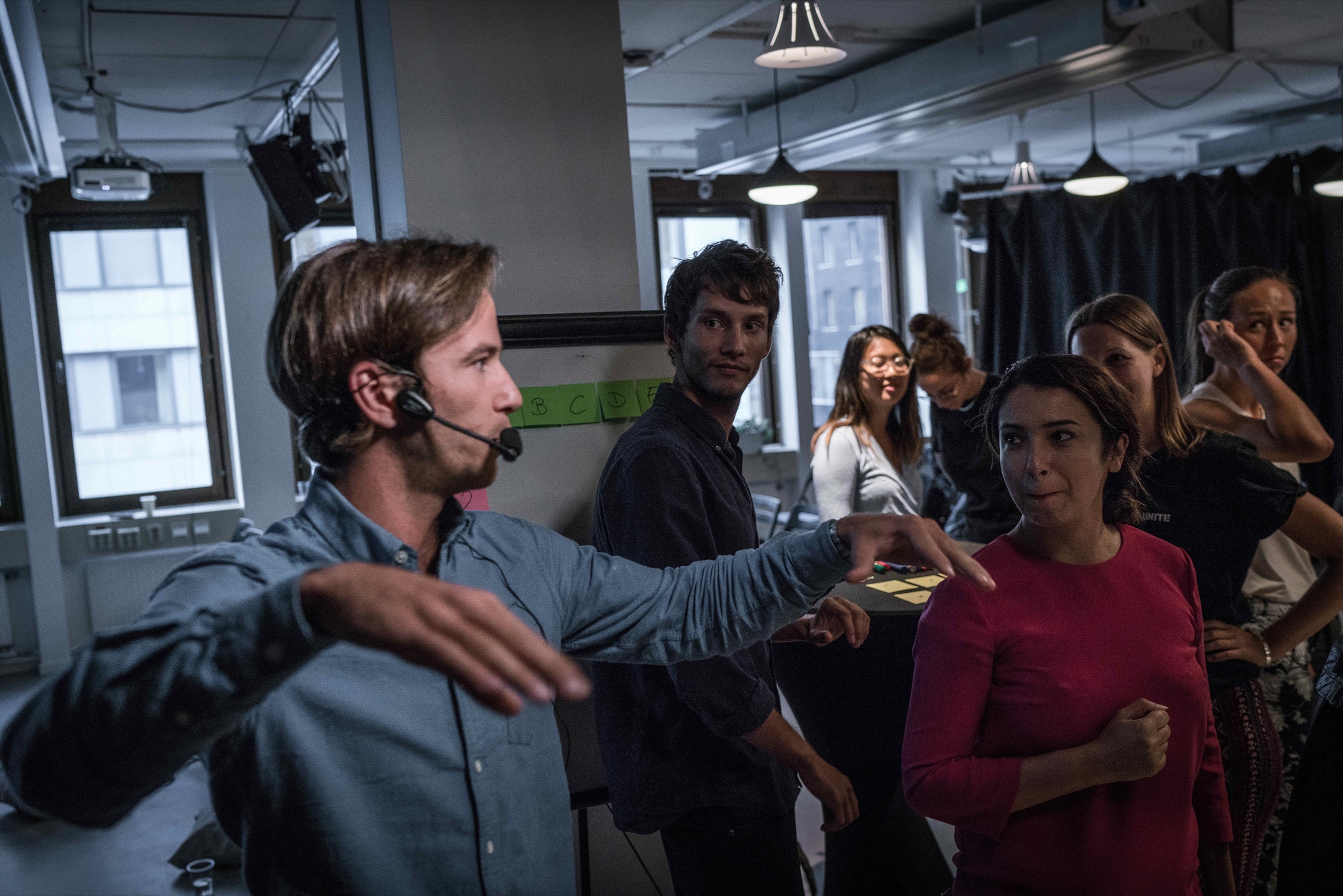

Facilitator and sprint lead
Viljar Rystad has facilitated more than 650 workshops for Norwegian companies.
He has led more than 35 innovation projects and trained more than 600 facilitators.




01
Sound familiar?
Drafts that used to take a week are ready in an hour. Signing off on them still takes a week.
Plans that used to hold for weeks now hold for days.
More people contribute outside their own field than before. Who signs off on what is shifting.
Much of this happens in tools the company neither sees nor has approved. This is what people call shadow AI.
Nobody is doing anything wrong here. The speed outran the structures meant to hold it together.
The last time something stalled in your team: did it produce another document, or a decision?
Do you have one workflow where this is happening right now? Then this is built for you.
Draw the Collaboration Map. Ten questions, two minutes, and you see where it stops in your team.
02
AI has made most things faster. What should collaboration look like now?
Expertise has spread out. What took a department a week, one person can now sketch in an afternoon.
At the same time, yesterday's way of working together was built for a different pace. Roles, approvals and plans are all moving at once. The bottleneck has shifted. From making, to agreeing.
As I see it, this is the best opportunity the team has had in a long time. The way you work together is being reassembled. The teams that do it deliberately, with one shared brain and one shared method, find their flow in the new reality first.
That is the job I help teams with.
03
One shared brain + method
What the team builds in the process is two things that belong together.
The first is a shared AI brain: a shared setup the whole team is connected to, always up to date. Five things live in it: the context the team works from, the skills the team uses, the connections to the tools around it, the routines that run on their own, and a tidy visual overview where everything relevant to the team is current and visible at all times. The brain remembers what the team knows, also when new people join, and when someone is away. The result is less coordination, less planning, less duplicated work. And better flow.
The second is the method you use it with. The team learns best practice for working with AI together: where AI helps, and where people decide. Who signs off on what. What never gets pasted into an AI tool. What counts as overuse, and where it can go wrong. What good quality means in your team. The rules are simple, written down and your own. And the gain is measured on the team's own numbers. That is how you get more out of AI, without it making decisions it should not make. And it is the start of a formal practice for safe and responsible use of AI, tested in the team's own work.
Only 26% of Norwegian businesses have formal processes for responsible AI. The method is that process, at team size.
And all of this happens
without anyone having to become an AI expert first,
without putting trade secrets, confidentiality or privacy at risk,
and without a large transformation project. You start with one team, one case and the tools you already have.
Based on Norwegian data: NHO/SØA 2026 · Statistics Norway · PwC CEO Survey Norway 2026.
04
How it works
One bounded process to change one real workflow.
/ 01
Week 0 · Setup
We choose the case and the workflow together with you, the person who owns it.
/ 02
Four sessions
SEE, TRY, LAND, DECIDE. Five to ten people.
/ 03
Decision
The decision date is agreed before we start.
/ 04
Day 30 · Measurement
We measure the effect on the three numbers the team chose.
We set up in week zero. Together we go through four workshops that fit your schedule, on a case you are already in. The decision date is agreed before we start. The effect is measured on the team's own numbers, on day 30.
This is not a general AI course or training in one tool. We work on one real workflow in your team, and you learn the AI and the tools along the way, on your own material.
AI training at team level. One real decision. One shared way of working. Measured on your own numbers.
05
What can you expect?
30–50%
faster from insight to decision. This is an estimate.
Our estimate for a process like this: 30 to 50 percent faster from insight to decision in the workflow we rebuild.
The research on individual AI use shows large gains at task level. In teams, much of that gain gets stuck in the gaps: in handovers, in waiting, in decisions that get reopened. When the team shares one AI collaboration system, with a shared AI brain underneath, that is the time you get back.
And because an estimate is never proof, every process is measured on the team's own numbers. Baseline in week zero. Follow-up measurement on day 30.
The experience behind it: more than 650 workshops and more than 35 innovation projects, for Orkla, Schibsted and several public-sector organisations. Orkla alone brought me back for seven sprints.
12 months → 3 months
from idea to market in an Orkla innovation project. That was before AI. Today this is possible in weeks, and available to everyone. And that changes how we work together.
«With traditional project work, it could easily take a year from the idea to the market. Now we can be in the market, testing, after three months.»
The numbers
What do the gaps cost today?
Set your own numbers and see.
≈ €160,000 a year
That is what the team spends on coordination and gaps today, based on the numbers you just set.
Potential at 30% faster€48,000
Potential at 50% faster€80,000
Not all of this should go away. Check-ins and planning have value. The potential lies in making them lighter.
This is an estimate. That is why every process is measured on the team's own numbers, from week zero to day 30.
The calculation is a rough estimate. The Collaboration Map shows where it leaks in your team.
Draw the mapTen questions, two minutes. Your number comes along.
Only eight percent of Norwegian leaders can document concrete gains from AI (Computas/Norstat 2026). The measurement in week zero and on day 30 is the way into those eight percent.
Why me
/ 01
The craft
The facilitation rests on more than 650 workshops and 600 trained facilitators. What is new is what AI makes possible in the room.
/ 02
AI native
Everything I build, for my own business and for others, is built with AI understanding and setup from the ground up.
/ 03
Bounded process
Fixed scope. Agreed decision date. Measured on your numbers on day 30. Then I step out.
06
What they say
The quotes are from the sprint years at Løpe, the studio I built and led from 2017 to 2023. Before AI. Same craft. Translated from Norwegian where needed.
«It was an extremely good process, and I recommend [Viljar] if you want to move forward fast. This is definitely something we will use again and again in the future.»
Tina Lindeloff, Business Development Director, Orkla Health
«I recommend Løpe as the go-to partner for Design Sprints in Norway»
Jake Knapp, author of Sprint
-
«It has been an incredibly fun, educational and intense sprint with Løpe. Great fun to go from a complex problem to a concrete product in just 4 days!»
Miriam Kringen Molnar, Manager Learning and Development, BDO
-
«I would really recommend Viljar and Løpe if you want to learn how to develop consumer-centric ideas fast»
Tone Glomnes, Head of Innovation, Orkla Health
-
«Løpe is the best Design Sprint partner we could imagine. Viljar pushed us to move fast and work efficiently together. The sprint strengthened our ability to collaborate and helped us understand where to go next.»
Stine Bakke-Haugseth, Head of Spinn, SpareBank 1
07
The way in
The process is simple.
A short conversation about fit.
A walkthrough of the workflow together with the person who owns it.
A recommendation with a fixed scope. We only start if the case is a good fit.
Bring one workflow that keeps stalling.
In 30 to 45 minutes we find out whether there is a concrete bottleneck worth testing.
Book a conversationWant to see where it stops first? Draw the Collaboration Map, two minutes. Then bring the map into the conversation.